

How Professional Detailers Remove Scratches From Your Car [Expert Tips]
Scratches are one of the most frustrating things to discover on your vehicle. Whether they come from tree branches, shopping carts, improper washing, road debris, or everyday wear and tear, even a small scratch can stand out on an otherwise clean, glossy finish.
Fortunately, many scratches can be significantly reduced or completely removed with professional detailing techniques. But how do professional detailers remove scratches from a car, and when is a scratch too deep to fix with detailing alone?
The answer depends largely on how deep the scratch penetrates your vehicle’s paint. Below, we’ll explain how professional scratch removal works, the techniques detailers use, and what you can do to prevent new scratches from appearing.
Understanding the Layers of Your Car’s Paint
Before trying to remove a scratch, it’s important to understand what’s underneath it. Automotive paint generally consists of several layers:
- Clear coat: The transparent protective layer on top of your paint.
- Base coat: The colored paint that gives your vehicle its appearance.
- Primer: A protective layer that helps the paint adhere to the vehicle.
- Metal or body panel: The underlying surface.
The depth of a scratch determines whether it can be polished out, requires more intensive paint correction, or needs actual body and paint repair.
Professional detailers begin by inspecting the scratch to determine which layer has been damaged.
What Types of Car Scratches Can Professional Detailers Remove?
Not every scratch requires repainting. Many common imperfections are contained entirely within the clear coat and can be corrected by an experienced detailer.
Clear Coat Scratches
Light scratches usually affect only the clear coat. These can result from improper washing, automatic car washes, drying your vehicle with dirty towels, brushing against branches, or minor everyday contact.
Clear coat scratches are generally the easiest type for a professional detailer to correct.
Swirl Marks
Those spiderweb-like marks you see when sunlight hits your vehicle aren’t usually deep scratches. They’re thousands of tiny imperfections in the clear coat.
Swirl marks commonly develop from improper washing and drying techniques, especially automatic car washes with rotating brushes. Professional polishing and paint correction services can dramatically improve or remove these imperfections.
Deeper Paint Scratches
If a scratch penetrates through the clear coat and into the colored base coat, removing it becomes more difficult.
A professional detailer may be able to make the scratch considerably less noticeable, but completely removing it could require touch-up paint or refinishing.
Scratches That Reach the Primer or Metal
Very deep scratches that expose primer or bare metal generally cannot be completely removed through detailing.
These scratches may require professional paint or body repair. They’re also worth addressing promptly because exposed metal can eventually develop corrosion.
How Do Professional Detailers Remove Scratches From a Car?
Professional scratch removal isn’t simply a matter of applying polish and rubbing until the scratch disappears. Experienced detailers evaluate the paint and use progressively more aggressive correction techniques only when necessary.
Here’s how the process typically works.
1. Thoroughly Wash and Decontaminate the Vehicle
Before performing paint correction, the surface needs to be completely clean.
Professional detailers wash the vehicle to remove dirt, road grime, and other contaminants. Depending on the condition of the paint, additional decontamination may be necessary to remove embedded particles. This is an important part of a professional exterior car detailing process.
Why does this matter?
Trying to polish contaminated paint can drag dirt or particles across the surface, potentially creating even more scratches.
2. Inspect the Scratch and Paint Condition
Once the surface is clean, the detailer can accurately evaluate the damage.
They’ll consider factors such as:
- Scratch depth
- Scratch location
- Condition of the clear coat
- Age and condition of the paint
- Previous paint repairs
- Surrounding swirl marks and imperfections
This assessment helps determine the safest correction method.
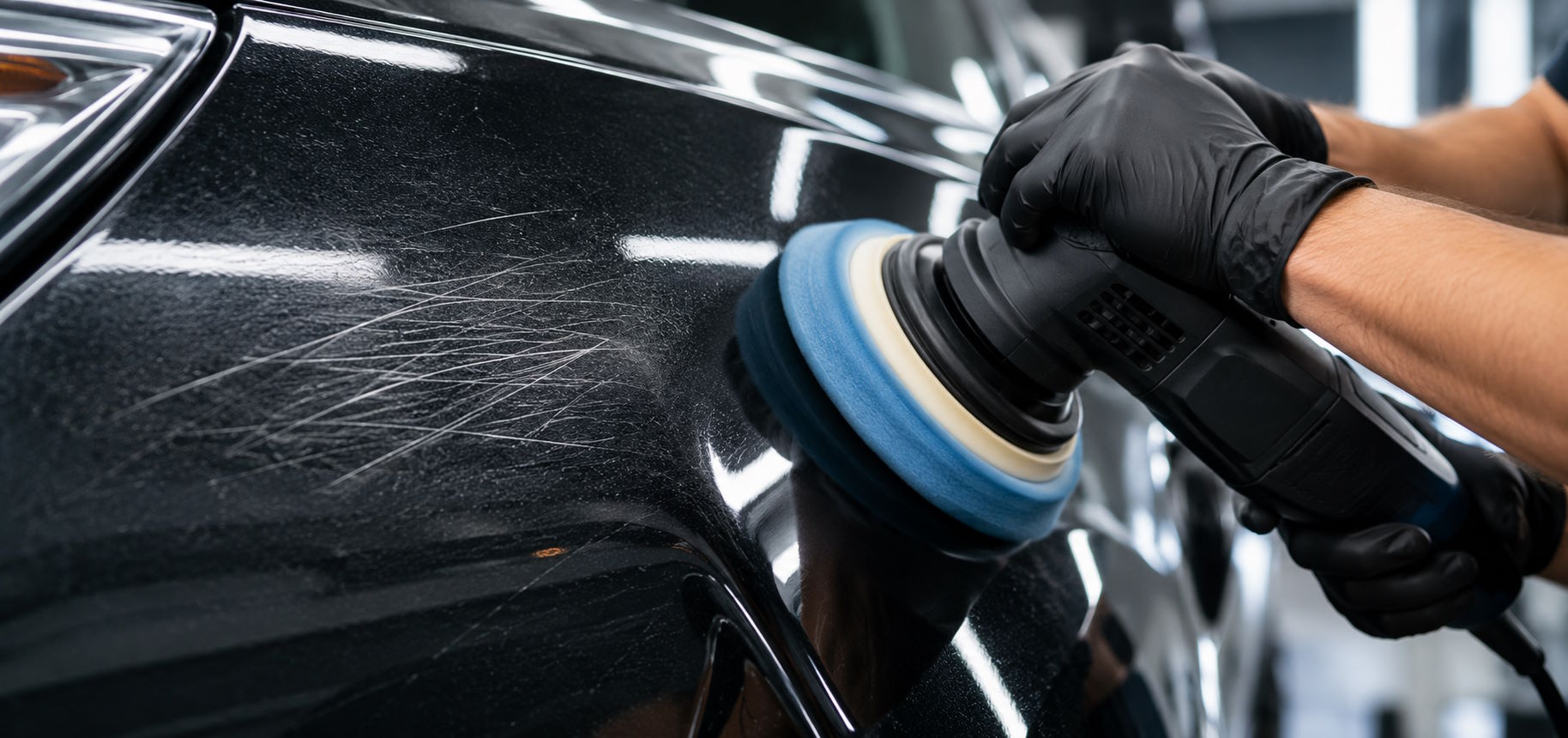
3. Machine Compound the Paint
For scratches that are too noticeable for light polishing, a detailer may use an automotive compound.
Compounding uses a combination of abrasive products, specialized pads, and a machine polisher to remove a microscopic amount of damaged clear coat surrounding the scratch.
The goal isn’t to “fill in” the scratch. Instead, the process carefully levels the surrounding clear coat so the defect becomes less visible or disappears.
This is why experience matters. Removing too much clear coat can permanently compromise the vehicle’s finish.
4. Polish the Surface
Compounding can leave behind slight haze or extremely fine marks. Polishing uses finer abrasives to refine the surface and restore gloss and clarity.
Depending on the condition of the vehicle, a detailer may perform a single-stage or multi-stage paint correction.
The result can be a dramatically smoother, deeper, and glossier finish.
5. Wet Sand When Necessary
Some deeper scratches may require wet sanding before compounding and polishing.
Wet sanding is a much more aggressive correction technique that uses extremely fine automotive sandpaper to carefully level the clear coat around an imperfection.
This isn’t something we’d recommend attempting without experience.
Removing too much material can penetrate the clear coat and cause permanent paint damage. Professional detailers use wet sanding selectively and only when the paint has enough material to safely correct the defect.
6. Protect the Corrected Paint
Once scratches and imperfections have been corrected, protecting the finish becomes important.
Depending on your goals, protection may include:
- Paint sealant
- Wax
- Ceramic coating
- Paint protection film (PPF)
A quality protective layer won’t make your vehicle scratch-proof, but it can help preserve the corrected finish and make routine maintenance easier. M&M offers several options for protecting professionally corrected paint, including ceramic coating and paint protection film.
Can Car Scratches Be Completely Removed?
Sometimes.
A good rule of thumb is that the shallower the scratch, the greater the likelihood it can be completely corrected.
Light clear coat scratches and swirl marks often respond extremely well to professional paint correction. Deeper scratches may only be improved rather than completely removed.
If the scratch has penetrated through the clear coat and removed the colored paint underneath, polishing alone can’t replace missing paint.
That’s why an experienced detailer should evaluate the damage before promising complete scratch removal.
Does the Fingernail Test Really Work?
You’ve probably heard the advice to run your fingernail across a scratch.
There is some truth to it.
If your fingernail doesn’t catch on the scratch, there’s a good chance the damage is relatively shallow and contained within the clear coat.
If your fingernail noticeably catches, the scratch may be deeper.
However, this isn’t a definitive diagnostic test. Paint thickness, clear coat condition, vehicle age, and previous repairs can all affect what correction techniques are appropriate.
A professional inspection is the best way to determine whether a scratch can safely be removed.
Can You Remove Car Scratches Yourself?
Some extremely light imperfections can be improved with consumer polishing products, but DIY scratch removal carries risks.
One of the biggest mistakes is becoming too aggressive.
Products marketed as scratch removers usually contain abrasives. Excessive rubbing, aggressive compounds, improper pads, or machine polishers used incorrectly can remove too much clear coat or leave behind haze, holograms, and additional scratches.
DIY touch-up paint can also make a damaged area more noticeable if the color doesn’t match or the paint is applied improperly.
If you’re dealing with an expensive vehicle, dark-colored paint, multiple scratches, or a scratch you can easily feel with your fingernail, having a professional inspect it first can help prevent additional damage.
What NOT to Use to Remove Scratches From Your Car
The internet is filled with unconventional car scratch removal tricks.
You may see recommendations involving toothpaste, baking soda, household cleaners, magic erasers, or other products that weren’t designed for automotive paint.
Avoid them.
Modern automotive clear coat requires products with predictable levels of abrasion. Household products can dull, haze, stain, or further scratch the finish.
Professional detailing products are specifically designed to correct automotive paint in a controlled manner.
How to Prevent Scratches After Paint Correction
After having scratches removed, proper maintenance can help keep your paint looking its best.
A few simple habits can make a big difference:
- Avoid automatic car washes that use brushes.
- Wash your vehicle using clean, high-quality microfiber mitts.
- Never wipe dirt or dust from dry paint.
- Use clean microfiber towels when drying.
- Remove bird droppings, bugs, and tree sap promptly.
- Don’t place bags, boxes, or other objects on painted surfaces.
- Consider ceramic coating or paint protection film for additional protection.
Proper washing technique is especially important. Many of the swirl marks and light scratches professional detailers correct are actually created during routine washing and drying.
Paint Correction vs. Scratch Removal: What’s the Difference?
The terms are often used interchangeably, but there’s a slight distinction.
Scratch removal focuses on correcting individual visible scratches.
Paint correction is a more comprehensive process designed to improve the overall condition of a vehicle’s paint by addressing imperfections such as:
- Scratches
- Swirl marks
- Oxidation
- Water spots
- Haze
- Etching
- Other clear coat defects
If your vehicle has one isolated scratch, targeted correction may be appropriate. If the entire finish shows swirl marks and imperfections, a complete paint correction may produce a much more noticeable improvement.
When Should You Take Your Car to a Professional Detailer?
Consider having your paint professionally evaluated if:
- You can see numerous scratches in direct sunlight.
- Your paint has extensive swirl marks.
- A scratch catches your fingernail.
- You’re unsure how deep the damage is.
- DIY products haven’t worked.
- You want to improve the vehicle before selling or trading it.
- You want the paint corrected before applying ceramic coating or PPF.
An experienced detailer can determine what’s realistically achievable while preserving as much clear coat as possible.
Professional Car Scratch Removal and Paint Correction in Connecticut
Car scratches don’t necessarily mean your vehicle needs to be repainted. Many scratches, swirl marks, and clear coat imperfections can be dramatically improved through professional compounding, polishing, wet sanding, and paint correction.
At M&M Auto Detailing, we can inspect your vehicle’s paint, determine the severity of the damage, and recommend the appropriate level of correction. Our goal isn’t simply to hide imperfections—it’s to safely restore as much clarity, depth, and gloss as the condition of your paint allows.
If scratches and swirl marks are taking away from your vehicle’s appearance, contact M&M Auto Detailing to learn more about professional paint correction and exterior detailing in Connecticut.